
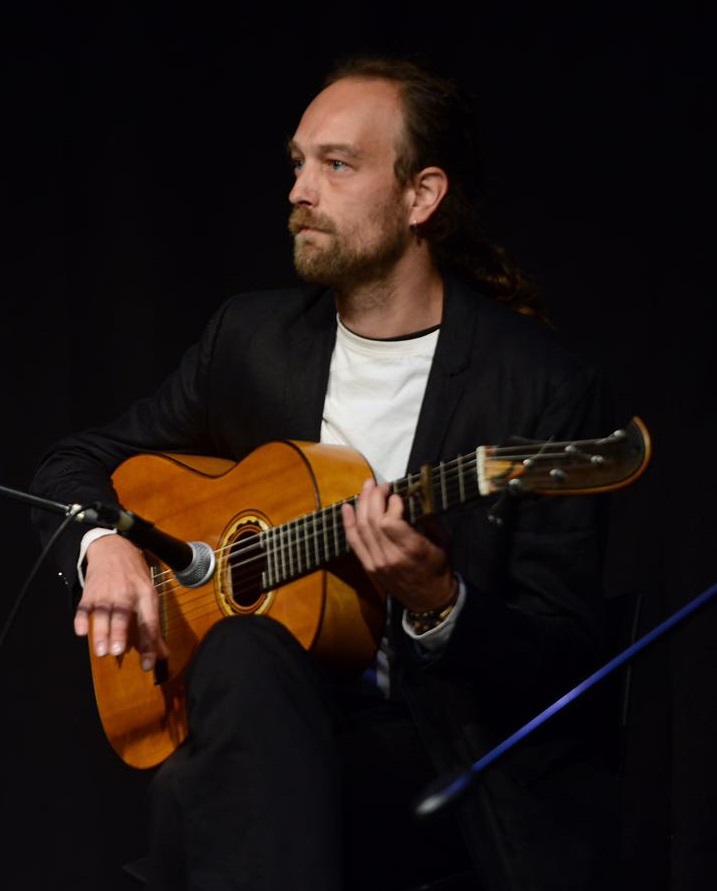
The flamenco guitar is much more than an accompanying instrument; it is the beating heart of flamenco, capable of expressing everything from the most exuberant joy to the deepest sorrow. For over two centuries, exceptional guitarists have transformed six strings into vehicles of pure emotion, developing techniques that have redefined not only flamenco, but music in general.
In this comprehensive guide, we explore the most influential flamenco guitarists in history, those virtuosos who took the flamenco style from the Andalusian taverns to the most prestigious stages in the world, and who with their creative genius expanded the expressive possibilities of the Spanish guitar.
The evolution of the flamenco guitar
Before we delve into the masters, it is important to understand how the guitar evolved within flamenco.
The origins: from sidekick to protagonist
In the early days of flamenco, the guitar was a secondary element, if not nonexistent. The earliest songs (tonás, martinetes, deblas) were performed "a palo seco," without instrumental accompaniment. The singing was king.
It was during the 18th century that the guitar began to be systematically incorporated into flamenco, initially with a purely accompanying role. The first flamenco guitarists adapted techniques from the Spanish classical guitar, but they soon developed their own unique musical language.
The birth of the "touch"
At the end of the 19th and beginning of the 20th centuries, the flamenco guitar began its emancipation. Guitarists began to be recognized by name, not just as "the one who accompanies so-and-so." They developed falsetas (instrumental variations), introduced the golpe (percussion on the guitar's soundboard), perfected the rasgueo and alzapúa (plucking techniques with the thumb), and created a unique technical vocabulary.
The flamenco "touch" was definitively distinguished from the classical guitar by its more percussive sound, its use of modal harmonies (not always tonal), its capacity for improvisation, and above all, by that indefinable quality called "compass" - the deep rhythmic sense that marks the difference between playing notes and making flamenco.
The flamenco guitar as an instrument
The modern flamenco guitar is also physically different from the classical guitar:
- Lighter wood (usually cypress for the back and sides, instead of the rosewood of the classical guitar)
- Thinner lid that responds more lively
- Lower action (strings closer to the fretboard) for easier speed
- Penetrations (transparent protective plates) on the lid to withstand the impact
- Brighter and more percussive sound, with less sustain than the classical guitar
The Pioneers: Forging the Language of Touch (1850-1920)
Paco el Barbero (1840-1910)
Francisco Sánchez Cantero, known as "Paco the Barber" because of his profession, is considered one of the first flamenco guitarists to be recognized as an independent artist, not just as an accompanist.
Contributions: Paco el Barbero was one of the first to give solo guitar recitals, without a singer. He developed falsetas that are still played today, especially in soleares and seguiriyas. His style laid the technical foundations upon which modern guitar playing would be built.
He worked extensively in the flamenco cafes of Seville, where he accompanied the best singers of his time, but he also had the courage to perform alone, demonstrating that the guitar could sustain the public's interest without singing.
Legacy: Although no recordings of Paco el Barbero exist (he died before the era of commercial recording), his influence was passed down orally through his disciples. Many traditional falsetas played today originated with this Sevillian master.
El Maestro Patiño (1829-1902)
Antonio Pérez Patiño was another pioneer of solo guitar playing. A native of Cádiz, he was known for his technical virtuosity and his ability to improvise variations on traditional themes.
Style: Patiño was known for his elegant and refined playing, with a preference for major keys and "sweeter" harmonies than other guitarists of his time. This earned him criticism from purists but also attracted a wider audience.
Innovations: He introduced harmonic elements taken from Spanish classical music, especially from composers like Fernando Sor. This fusion enriched the harmonic vocabulary of flamenco.
Javier Molina (1868-1956)
Molina, from Jerez, represents the bridge between 19th and 20th century flamenco. He lived long enough to record, leaving us an invaluable sound record of what flamenco guitar playing sounded like in the late 19th century.
Characteristics: His playing was understated, deeply rhythmic, without unnecessary embellishment. Every note had a purpose, every falsetto served the beat. He was the epitome of the perfect accompanist, but he could also shine in solos.
Recording legacy: His recordings from the 1920s and 30s are historical documents that allowed later generations to study the playing of the golden age of the café cantante.
The Golden Age: Masters of the Café Concerts (1920-1960)
Ramón Montoya (1879-1949)
If there is one guitarist who revolutionized flamenco and elevated it to the level of concert art, it was Ramón Montoya. Born in Madrid into a Gypsy family, Montoya completely transformed what could be done with a flamenco guitar.
Technical revolutions:
- First flamenco guitar recital in a serious theater: In 1936 he played solo at the Teatro Calderón in Madrid, demonstrating that the flamenco guitar deserved the same respect as the classical guitar.
- Incorporation of complex arpeggios: Until Montoya, flamenco arpeggios were relatively simple. He introduced harmonic patterns inspired by the classical guitar but adapted to the flamenco idiom.
- Bold modulations: He was not afraid to change key within the same piece, something uncommon in traditional flamenco.
- Melodic falsetas: He created falsetas with singable melodic lines that greatly enriched the repertoire.
Legendary Recordings: Montoya recorded extensively from the 1920s to the 1940s. His 78 rpm records are highly sought-after treasures for collectors. Pieces like his rondeña in E major or his farruca are essential studies for any flamenco guitar student.
Collaborations: He accompanied the best flamenco singers of his time: La Niña de los Peines, Manuel Torre, Pepe Marchena. His sensitivity as an accompanist was as extraordinary as his solo virtuosity.
Influence: Virtually all subsequent flamenco guitarists have been influenced by Montoya. Paco de Lucía said of him: "Without Ramón Montoya, modern flamenco would not exist as we know it."
Niño Ricardo (1904-1972)
Manuel Serrapí Sánchez, "Niño Ricardo," was the guitarist who best knew how to combine flamenco purity with harmonic sophistication. A native of Seville, his playing was the quintessential Andalusian flavor.
Distinctive features:
- Impeccable timing: His sense of rhythm was absolute. He could subtly speed up or slow down within the measure, creating dramatic tension.
- Clean and crystalline touch: Each note sounded perfectly defined, without smudges or inaccuracies.
- Masterful accompaniment: He was the preferred guitarist of Antonio Mairena, one of the most demanding flamenco singers in history. His ability to "dress" the singing without overshadowing it was unique.
- Harmonic innovations: He introduced seventh, ninth and other "modern" harmonies but always in service of flamenco, never as a gratuitous display.
Famous Compositions: His soleá por bulería "Niño Ricardo" is one of the most frequently performed pieces in the flamenco repertoire. His tarantas and granaínas are studies in how to build tension and release in modal music.
Sevillian School: Niño Ricardo founded a school of guitar playing that emphasized elegance, good taste, and respect for rhythm over empty virtuosity. This philosophy profoundly influenced later generations.
Sabicas (1912-1990)
Agustín Castellón Campos, «Sabicas», was the guitarist who brought flamenco to the international public and proved that the solo guitar could fill auditoriums without the need for a singer.
International career: Exiled in the United States after the Spanish Civil War, Sabicas spent decades performing in New York and around the world. He was the first flamenco guitarist that many foreigners heard.
Technical virtuosity: Sabicas was an astonishing virtuoso. His speed in dives (fast scales), the clarity of his tremolo, and his ability to execute technically devilish passages were legendary.
Repertoire: He recorded more than 50 albums, exploring all the styles of flamenco. His falsetas became a standard of the repertoire, studied by guitarists all over the world.
Innovations:
- Incorporation of Latin rhythms: Living in America, he subtly integrated Caribbean rhythms that enriched his rhythmic palette.
- Flamenco concert guitar: He developed a style of performance designed for large auditoriums, with exceptional projection and clarity.
- Transcriptions: He was one of the first to allow his works to be transcribed into sheet music, facilitating the academic study of flamenco.
Friendly rivalry: His relationship with Paco de Lucía (whom he met when Paco was a child) was one of mutual respect. Sabicas represented traditional virtuosity; Paco, harmonic innovation. Together, they defined the poles of modern guitar playing.
Mario Escudero (1928-2004)
Less well known than Sabicas but equally influential, Mario Escudero was another great ambassador of flamenco in the United States.
Style: Where Sabicas was fire and virtuosity, Escudero was elegance and refinement. His touch was more intimate, with an emphasis on melodic expressiveness.
Contribution: He accompanied legendary flamenco dancers such as Carmen Amaya and Pilar López, demonstrating that dance guitar requires as much artistry as solo guitar. He was also an excellent teacher, training generations of American guitarists.
The revolution: Paco de Lucía and his generation (1960-2014)
Paco de Lucía (1947-2014)
Francisco Gustavo Sánchez Gómez, "Paco de Lucía", was not only the best flamenco guitarist of his generation; he was the musician who completely transformed the genre, taking it to territories that no one had imagined.
Formative Years: Born in Algeciras (Cádiz), Paco grew up in a family of musicians. His father, Antonio Sánchez, a frustrated guitarist, subjected Paco and his brothers to a fierce discipline of practice. By the age of 12, Paco was already a professional, accompanying flamenco singers in flamenco venues.
The partnership with Camarón: His collaboration with the flamenco singer Camarón de la Isla (1969-1992) produced some of the most influential albums in flamenco history. Albums like "La Leyenda del Tiempo" (1979) were revolutionary, incorporating drums, electric bass, Indian flute, and jazz harmonies into traditional flamenco. It was tremendously controversial but changed the genre forever.
Musical innovations:
- Jazz Harmonies: Paco intensively studied jazz guitarists like Joe Pass and Wes Montgomery. He incorporated harmonic substitutions, altered chords, and harmonic progressions from jazz without losing the flamenco flavor.
- Exotic scales: He introduced scales from Indian, Arabic, and Brazilian music, creating a vastly expanded harmonic language.
- Right-hand technique: He developed picking and up-picking patterns of unprecedented complexity, in addition to perfecting the tremolo to virtuosic levels.
- Revolutionary rhythm: In pieces like «Entre dos aguas» (1973), he played with compound rhythms and polyrhythms in a radically new way.
Sexto: He formed a sextet that included flute, saxophone, bass, and flamenco cajón (an instrument he popularized after discovering it in Peru). This format allowed for complex arrangements impossible with just a guitar.
International career: He performed on the world's most prestigious stages: Carnegie Hall, Royal Albert Hall, Sydney Opera House. He collaborated with John McLaughlin, Al Di Meola, and Chick Corea, demonstrating that flamenco could engage in a dialogue of equals with the most sophisticated jazz.
Immortal compositions:
- «Entre dos aguas»: A flamenco rumba that became a commercial hit, selling millions. It introduced flamenco to mass audiences.
- «Río Ancho»: Bulería that is a required study for every flamenco guitarist.
- «Almoraima»: Full album (1976) considered one of the peaks of solo playing.
- Concierto de Aranjuez: His orchestral interpretation of Joaquín Rodrigo's famous concerto is considered definitive.
Legacy: Paco de Lucía died suddenly in Mexico in 2014, but his influence is immeasurable. He expanded the possibilities of flamenco without betraying its essence. He demonstrated that it was possible to innovate radically while maintaining the duende (the soul or spirit of flamenco). He inspired not only flamenco musicians but guitarists of all genres. He is, quite simply, the most important flamenco guitarist in modern history.
Manolo Sanlúcar (1943-2022)
A contemporary of Paco de Lucía, Manolo Sanlúcar took a different but equally revolutionary path: the symbiosis between flamenco and classical music.
Unique Training: Sanlúcar formally studied classical harmony and composition, something rare among flamenco artists of his generation. This allowed him to write works of great structural complexity.
Symphonic Compositions: He wrote concertos for guitar and orchestra, flamenco operas, and chamber works that combined flamenco with contemporary art music. His "Tauromagia" (a suite about bullfighting) and "Medea" (a flamenco opera) are masterpieces.
Philosophy: For Sanlúcar, flamenco should evolve by incorporating all the richness of Western classical music without losing its essence. He believed that flamenco was as worthy as Beethoven and should occupy the same spaces.
Technique: Although less flashy and virtuosic than Paco, his technique was impeccable. His profound harmonic knowledge allowed him to create richly textured instruments.
Influence: He demonstrated that there were multiple paths to renewing flamenco. His "classical" route inspired later composers who wanted to work with extended forms and complex thematic developments.
Serranito (1942-presente)
Víctor Monge «Serranito» represented the purest flamenco branch of innovation, without straying as far from the genre as Paco.
Style: Serranito perfected an incredibly fast playing style, with lightning-fast strumming and astonishingly clean picking. His sound was quintessentially flamenco: percussive, rhythmic, visceral.
Dance accompaniment: He was the preferred guitarist of some of the best flamenco dancers. His ability to "mark" (provide the perfect rhythmic support for the dancer) was legendary.
Compositions: His tarantas and granaínas are among the best in the repertoire. He preferred depth to radical experimentation.
Generational bridge: He trained numerous guitarists who are now established figures, transmitting the tradition of deep and respectful playing with the rhythm.
Contemporary Masters (1980-present)
Tomatito (1958-presente)
José Fernández Torres, "Tomatito", was Camarón's guitarist after Paco de Lucía, an immense responsibility that he assumed brilliantly.
With Camarón: He accompanied Camarón during his last decade (1982-1992), participating in fundamental albums such as "Soy Gitano" and "Potro de rabia y miel". His playing was the perfect complement to the singer's voice: sensitive, rhythmic, with a deep Gypsy flavor.
Solo career: After Camarón's death, Tomatito developed an extraordinary solo career. His album "Barrio Negro" (1991) is considered a masterpiece of modern rock.
Style: Tomatito combines technical virtuosity with pure Gypsy soul. His playing has swing, flavor, that indefinable something that only the greats possess. He is especially masterful in bulerías and tangos.
Collaborations: He has worked with jazz musicians (Michel Camilo, Chano Domínguez), Latin music (Alejandro Sanz), and even flamenco-pop, always maintaining his identity.
Legacy: He represents the continuation of the Paco de Lucía line: technical and harmonic innovation without losing the traditional flamenco flavor. He is possibly the most complete guitarist of his generation.
Vicente Amigo (1967-presente)
Vicente Amigo, from Córdoba, represents the perfect fusion between dazzling technique and profound expressiveness.
Training: He studied with Manolo Sanlúcar, from whom he inherited an interest in structured composition and sophisticated harmony.
Style: Vicente has an immediately recognizable personal sound: melodic, sweet, but powerful when necessary. His compositions are elaborate, with careful thematic development.
Acclaimed Albums: «Ciudad de las Ideas» (2000) won a Latin Grammy. «Tierra» (2013) and «Memoria de los Sentidos» (2017) confirm his mastery.
Innovation: It incorporates elements of flamenco, jazz, classical, and world music without sounding forced. It makes extensive use of the looper and effects (in moderation) to create textures impossible with just a guitar.
Technique: A complete virtuoso, he masters all technical aspects but never shows off gratuitously. Every note serves the musical expression.
Gerardo Núñez (1961-presente)
Born in Jerez, Núñez is perhaps the most experimental of the great contemporary guitarists.
Harmonic exploration: He has taken flamenco harmony into atonal and dissonant territories when the music demands it, something unthinkable in previous generations.
Composition: He writes complex works that require multiple listenings to fully appreciate. It is not "easy" music, but it is deeply rewarding.
Collaborations: He has worked with contemporary music, avant-garde jazz, and electronic music. His stylistic openness is complete.
Respect from purists: Despite his experimentation, the most traditional flamenco artists respect Núñez because his mastery of pure flamenco guitar playing is unquestionable. He can play the most profound flamenco with absolute authenticity.
Cañizares (1966-presente)
Juan Manuel Cañizares represents another way of fusion: flamenco with world music, especially oriental music.
Classical training: He formally studied classical guitar, which gave him extraordinary technique and a deep knowledge of classical repertoire.
Fusions: He has collaborated with Arab, Indian, and African musicians, exploring the points of convergence between flamenco and other musical traditions. His flamenco-Arabic projects are particularly successful, reconnecting flamenco with its Eastern roots.
Versatility: He can play pure flamenco, Spanish classical music, jazz, and contemporary music. This versatility has opened doors to unique projects.
National Orchestra of Spain: He has been a frequent guest soloist, performing everything from Rodrigo to premieres of contemporary composers who write specifically for his flamenco guitar.
Rafael Riqueni (1962-presente)
From Seville, Riqueni is the most ambitious composer in flamenco today.
Extensive Works: He has composed 20-30 minute suites, flamenco operas, and concertos. His vision of flamenco is architectural, building large musical structures.
Harmony: His harmonic knowledge is probably the deepest of all flamenco guitarists. He uses reharmonizations, remote modulations, and highly sophisticated harmonic progressions.
Melancholy: His music has a distinctive melancholic tone. Even his alegrías have a certain underlying sadness. It is deeply intimate flamenco.
Influence of Paco: Riqueni studied with Paco de Lucía and the influence is audible, but he has developed a completely personal voice.
Late Recognition: Although always respected by musicians, his popular recognition came later than others of his generation. Today he is considered one of the most important flamenco composers.
The new generation: the future of touch (2000-present)
Dani de Morón (1981-presente)
From Moronense, Dani represents the new generation of guitarists who have grown up studying Paco but are looking for their own voice.
Modern Technique: Absolute mastery of all traditional techniques plus his own innovations. His tremolo and staccato are impeccable.
Accompaniment: He is the preferred guitarist of some of today's best flamenco singers (Arcángel, Miguel Poveda). His sensitivity as an accompanist is extraordinary.
Composition: His falsetas are already a standard studied by students. He has a special melodic gift.
Respect for tradition: Despite his youth and modern techniques, he deeply respects tradition. He doesn't innovate for the sake of innovation, but only when he has something genuine to contribute.
Diego del Morao (1979-presente)
The son and grandson of legendary guitarists (Morao family from Jerez), Diego leads one of the most important flamenco dynasties.
Jerez flavor: His playing has that deep, rhythmic, and visceral Gypsy flavor of Jerez. It's pure, uncompromising flamenco.
Accompaniment: He has accompanied José Mercé, Duquende, and Enrique Morente. He is considered one of the best accompanists of his generation.
Family tradition: He continues the legacy of his father Moraíto Chico and his grandfather Manuel Morao, demonstrating that flamenco dynasties are still alive.
Innovation from tradition: Although it deeply respects family tradition, it is not a mere imitator. It contributes its own elements while maintaining the essence.
Antonio Rey (1981-presente)
Born in Madrid to a Gypsy family, Antonio Rey is the quintessential virtuoso of his generation.
Speed: His speed of execution is astonishing. His footwork is possibly the fastest in flamenco today.
Stylistic breadth: She moves with ease between pure flamenco, fusion with jazz, and contemporary classical music. She has performed with symphony orchestras and at jazz festivals.
Experimental projects: He is not afraid to experiment. He has incorporated electronics, loops, and effects, always with respect for flamenco.
Pedagogy: He is also a teacher, passing on knowledge to the next generation through masterclasses and online videos.
Niño de Pura (1984-presente)
Jerezano, represents the most traditional touch of the new generation.
Pureza: Their commitment is to deep, authentic flamenco, without commercial concessions. It's flamenco for flamenco lovers.
Dance accompaniment: Specialist in playing for dance, where the guitarist must be completely subordinate to the dancer, maintaining impeccable rhythm.
Continuity: Represents the line of continuity with masters like Niño Ricardo, demonstrating that the traditional touch remains alive and relevant.
Women guitarists: breaking barriers
Históricamente, la guitarra flamenca ha sido dominio casi exclusivo masculino. Pero esto está cambiando.
Antonia Jiménez
An absolute pioneer, she was one of the first professional female flamenco guitarists, active since the 1980s.
Barreras: She faced tremendous prejudice. Many fans simply couldn't accept that a woman could play at the level of men.
Technique: She more than proved that gender does not determine ability. Her technique was impeccable and her expressiveness, profound.
Legacy: She opened doors for later generations of female guitarists.
Cañizares (Laura)
Not to be confused with Juan Manuel Cañizares. Laura represents the new generation of female guitarists.
Complete training: Studied at conservatories, masters classical and flamenco repertoire.
International projection: She performs regularly at international festivals, demonstrating that female guitarists can have top-level careers.
The pending revolution
Although there has been progress, female guitarists remain a minority in flamenco. The reasons are complex: cultural traditions, a lack of role models, and persistent prejudices. But the trend is clear: more and more girls are studying flamenco guitar, and the next generation of great masters will almost certainly include more women.
Conclusion: An art in constant evolution
The history of the flamenco guitar is that of an instrument that went from humble accompaniment to absolute protagonist, from Andalusian taverns to the most prestigious stages in the world.
Each generation of guitarists has pushed the boundaries of what's possible, expanded the technical and harmonic vocabulary, and explored new fusions. And yet, the essence remains: that deep rhythm, that unique percussive sound, that spirit that sends shivers down your spine.
The masters mentioned here are just the tip of the iceberg. There are hundreds of extraordinary guitarists who deserve recognition. But these names represent the milestones, the revolutions, the moments when the art took a qualitative leap.
The future of flamenco guitar is bright. More people are studying it than ever before, there are more interesting fusions, and it enjoys greater academic respect. But there are also voices warning about the loss of traditional flavor, excessive academicization, and the dilution of the genre into soulless fusions.
The debate is healthy. Flamenco has always thrived on the tension between tradition and innovation. As long as there are guitarists with rhythm, sound, flair, and soul, flamenco will continue to live, evolve, and move us.
Because in the end, what makes a flamenco guitarist great isn't Grammys, or concerts at Carnegie Hall, or technical innovations. It's that ability to make six strings tell stories, express emotions without words, and connect with something deep in our shared humanity.
From the hands of Paco de Lucía to the rising stars of 2026, the guitar has been the driving force behind the evolution of this art form. To see how these masters have influenced today's major events, consult our calendar of Flamenco Festivals in Spain, where the guitar remains the undisputed queen.
No responses yet