
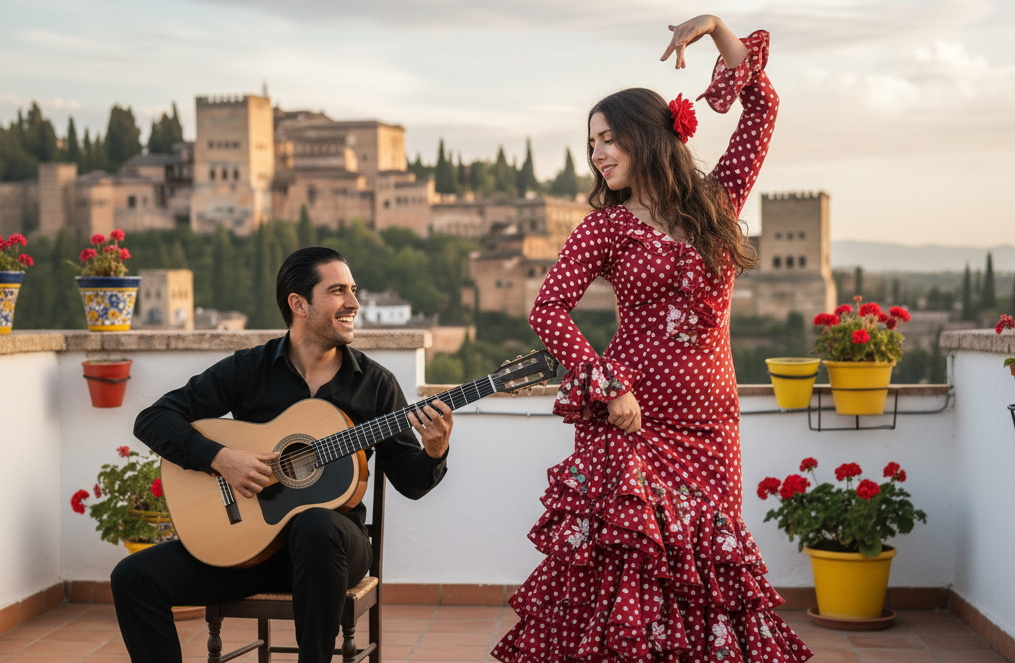
The flamenco dress is much more than a gown; it's a symbol of cultural identity, a work of art in motion, and an expression of the wearer's personality. Every year, especially during Seville's April Fair and the Andalusian pilgrimages, thousands of women wear spectacular flamenco dresses that combine centuries-old tradition with the latest fashion trends.
In this comprehensive guide to flamenco dresses for 2026, you'll discover everything you need to know: the history and evolution of the flamenco dress, current trends, how to choose the perfect dress according to your body type, essential accessories, where to buy (both in physical stores and online), maintenance tips, and how to distinguish a quality dress from a mediocre one.
History of the flamenco dress: from work clothes to fashion icon
The flamenco dress we know today has humble roots that go back to the 19th century.
Origins: the clothing of the workers
Contrary to popular belief, the flamenco dress did not originate as dance or celebratory attire. It was originally the everyday clothing of working women in the Andalusian countryside and Roma women who sold goods in markets.
Original Features:
- Plain cotton fabric: No silks or satins. Economical and durable materials.
- Subdued colors: Blacks, browns, maroons. Bright colors were expensive.
- Ruffled skirt: Not for aesthetics but for functionality. The ruffles (or flounces) served as a barrier against road dust and protected the petticoats.
- Long sleeve: Protection against the Andalusian sun.
- Handkerchief or shawl: It covered the head and shoulders, again for sun protection and modesty.
Evolution in the 19th Century
During the livestock fairs held in Seville and other Andalusian cities, women began to adorn these basic dresses for the evening celebrations that accompanied the trade.
Gradual changes:
- The introduction of brighter colors when dyes became cheaper
- Lighter and more colorful fabrics for festive occasions
- More ruffles as a decorative element, not just a functional one
- A deeper neckline in festive contexts
Early 20th century: the codification of dress
In the early 1900s, the flamenco dress began to be codified with recognizable characteristics that persist today:
Defining elements:
- Fluttered skirt: With a minimum of two or three ruffles (although up to 7-8 were used)
- Defined waist: Silhouette that emphasizes the female figure
- Three-quarter or long sleeve: Usually with a ruffle at the cuff
- V-neck or strapless: Depending on the current fashion trends
- Specific accessories: Shawl, hair comb, flowers, earrings
The April Fair: a catalyst for flamenco fashion
The Seville April Fair, which began as a livestock fair in 1847, gradually transformed into a cultural celebration where showing off the flamenco dress became central.
From the 1920s and 30s onwards, the Feria became an unofficial catwalk where annual trends were set. Designers began to specialize in flamenco dresses, elevating the garment from a popular item to a haute couture creation.
Second half of the 20th century: professionalization
1950s-60s: Designers like Lina (from Seville) began creating annual collections. The suit became more stylized, refined, and moved further away from its humble roots.
1970s-1980s: Explosion of specialized workshops. Flamenco dresses became a major industry in Andalusia. The first magazines specializing in flamenco fashion appeared.
1990s-2000s: Mutual influence between flamenco fashion and conventional haute couture. Designers like Victorio & Lucchino incorporated flamenco elements into their collections, while flamenco dressmakers adopted haute couture techniques and trends.
21st Century: Globalization and Democratization
Today, the flamenco dress is a global phenomenon. It's sold online to buyers all over the world. Flamenco fashion influencers have hundreds of thousands of followers. Major department stores like El Corte Inglés dedicate entire floors to flamenco dresses during the season.
But there's also a movement back to artisanal craftsmanship. Many women are seeking unique, custom-made dresses crafted by traditional dressmakers, rejecting mass production.
Anatomy of the perfect flamenco dress
To understand what makes a suit exceptional, you need to know its components.
The skirt: the heart of the outfit
Long: Traditionally ankle-length, showing only the shoes. Trends vary; some years shorter (midi) styles are worn, others return to the classic length.
Flow: The width of the skirt determines how it moves. A dress with too little flare looks stiff. Too much flare can be difficult to handle. The perfect balance allows for fluid movement without being overwhelming.
Ruffles (faralaes):
- Number: From 2 to 6+ ruffles. More ruffles = more spectacular but also more weight and heat.
- Width: Narrow ruffles (10-15cm) give a streamlined look. Wide ruffles (25-30cm) give dramatic volume.
- Finish: They can be with a simple hem, with bias binding (tape that borders the ruffle), with lace, with trimmings.
Godets: Triangular pieces inserted into the skirt to give extra fullness without adding volume at the hips. A well-constructed dress has strategically placed godets.
Tail: Some costumes have a tail (a longer rear extension). It's spectacular, but it requires practice to walk without stepping on it.
The body or bodice
Types of neckline:
- Strapless: Without straps, supported by an internal structure. Elegant but requires a good pattern so it doesn't keep tugging all day.
- Straps: They can be thin or wide, straight or crossed. More comfortable for women with a larger bust.
- V-neck: Classic, flattering for most body types.
- Asymmetrical: Modern trend, one shoulder covered and the other bare.
- Long or three-quarter sleeve: It can be integrated into the body or be part of a separate jacket.
Fit: The garment should fit like a second skin without being too tight. It should provide support without needing to be pulled. A well-made pattern distributes tension evenly.
Fitting: The waist should be defined. It can be natural (at your actual waistline) or slightly lower (more flattering for some figures).
The sleeves
Types:
- Long sleeve: Classic, elegant, covers up to the wrist.
- Three-quarters: Ends between elbow and wrist. Practical for hot weather.
- Short sleeve: Modern, fresh. Less traditional but increasingly accepted.
- Cape sleeve: Dramatic, falls like a cape from the shoulder.
Sleeve ruffles: Most have a ruffle at the cuff. It can be single or double, narrow or wide. The ruffle should allow unrestricted wrist movement.
The waist or jacket
Some women prefer a two-piece suit: skirt + jacket (or waist) separately.
Advantages:
- Greater versatility (you can combine it with other skirts)
- Easier to go to the bathroom (yes, it's an important consideration at the Fair)
- Custom adjustment up and down
Types of jacket:
- Short: Ends at or just below the waist. Emphasizes the figure.
- Long: Reaching the hip. More flattering for some figures.
- With buttons or invisible closure: Aesthetic vs practical.
Flamenco dress trends 2026
Flamenco fashion evolves every year. These are the dominant trends for 2026:
Fashion colors
Earth Tones Revalued: After years of vibrant colors, there's a return to terracotta, mustard, olive green, and warm browns. It's sophisticated, elegant, and less obvious.
Intense fuchsias and magentas: For those who want to stand out. Electric fuchsia is especially strong.
Klein blue and deep indigos: Saturated blues that contrast beautifully with Andalusian gold.
Whites and creams: Off-white or off-cream (not pure white) is a strong trend. Combined with tone-on-tone lace or embroidery.
Large floral prints: Oversized floral prints, especially on dark backgrounds. It's dramatic and very flamenco.
Strategic Bicolor: Combining two colors (not random patchwork, but deliberate design). For example, a black bodice and a red skirt, or ruffles alternating between two shades.
Trendy fabrics
Premium Cotton: A return to natural materials. High-quality, well-treated, breathable cotton. It's a reaction against cheap synthetic satins.
Linen blend: A linen-cotton blend that combines the drape of cotton with the texture of linen. Perfect for warm weather.
Heavy crepe: A fabric with a grainy texture that drapes beautifully. It provides structure without stiffness.
Lace and guipure: Integrated, not just as decoration. Bodices entirely in lace, ruffles with lace inserts.
Plumeti: The classic fabric with embroidered polka dots is making a strong comeback. It's nostalgic, sweet, and very spring-like.
Silhouettes and cuts
Extremely fitted silhouette: Very defined waist, almost corset-like. Requires expert pattern making, but the result is spectacular.
Deliberate asymmetries: One shoulder, diagonal cuts, ruffles that start at different heights.
Minimalism in ruffles: Fewer ruffles, but wider and more elaborate. Instead of 6 small ruffles, 2-3 large ones with intricate details.
Back as the Star: Deep backless designs, sheer fabrics, and lace details. If the front is conservative, the back is a showstopper.
Midi length: Skirts that end at mid-calf. It's modern, practical, and flattering for petite women.
Details and finishes
XL Embroidery: Large embroidery, visible from afar. Embroidered flowers the size of a hand.
Structured pleats: On the bodice or the beginning of the skirt. They give a three-dimensional texture.
Strategic transparencies: Tulle or lace in specific areas (sleeves, neckline, waist). It suggests without revealing.
Self-moving steering wheels: Steering wheels with built-in wire or structured to maintain a specific shape.
Mix of textures: Combine satin with lace, cotton with tulle, plain with polka dots in the same outfit.
Essential accessories for a flamenco dress
The suit is only part of the outfit. The accessories are essential.
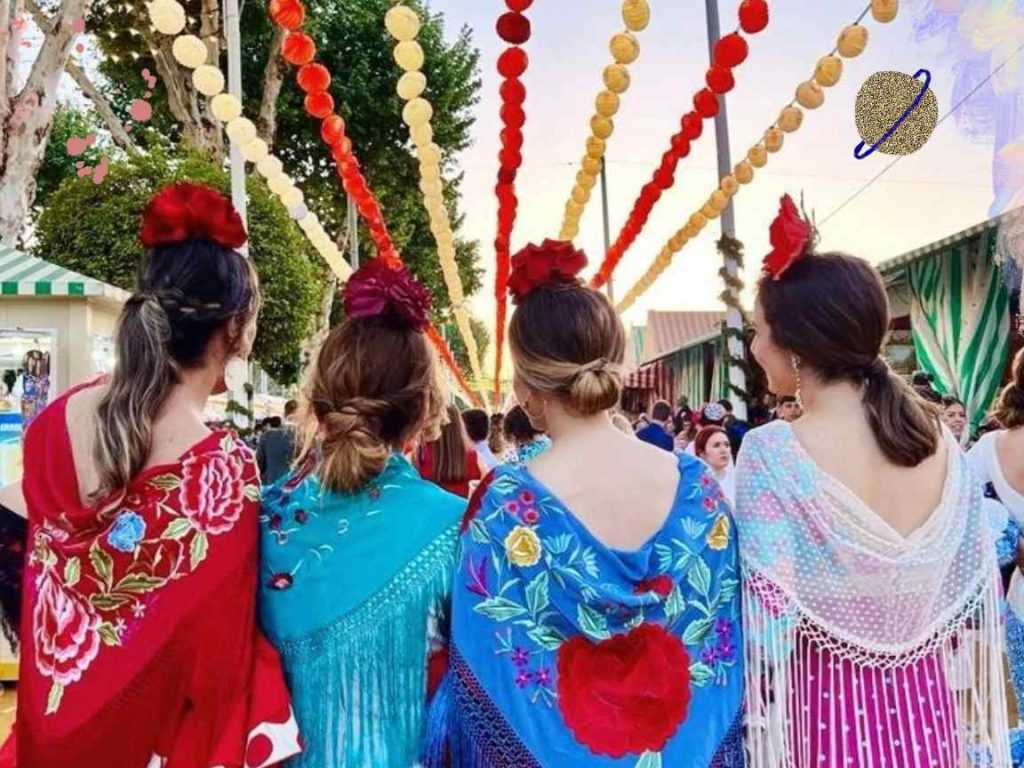
Manila shawl or shawl
History: The Manila shawl originally came from China (not Manila), arriving in Spain via the Philippines (hence "Manila"). They are pieces embroidered in silk with long fringes.
Types:
- Authentic Manila shawl: Hand-embroidered silk, 60-80cm fringe. Can cost thousands of euros. They are family heirlooms.
- Modern shawl: Imitations in synthetic materials, machine embroidered. From €50.
- Mantoncillo: A smaller, lighter version. More practical for wearing all night.
How to wear it:
- Folded into a triangle, with the point at the back
- It fastens with a special pin (not a regular safety pin)
- It should reach at least to the middle of the thigh
- The fringes should hang evenly.
Coordination: It can be the same color as the suit (tonal), contrasting, or neutral (black, white, cream go with everything).
Comb and flowers
The hair comb: A tall decorative comb that is placed in the bun.
Types:
- Tortoiseshell (or imitation): Classic, elegant, discreet
- Decorated: With rhinestones, inlays, carvings
- Sizes: From 8cm to 20cm+ in height
Placement: It goes behind the bun, slightly tilted back. Secure with bobby pins so it doesn't move.
The flowers: Traditionally carnations or roses.
Options:
- Natural flowers: Authentic but they don't last long (one day maximum)
- Fabric Flowers: Reusable, endless variety
- Floral headdresses: Arrangements made with multiple flowers, leaves, feathers
Placement: Generally on one side of the head (left or right according to preference). They can be worn individually, in a group, or as part of an elaborate headdress.
Size: Proportional to your size and the dress. Petite women with huge flowers look overwhelmed. Large women with tiny flowers look disproportionate.
Flamenco earrings
Characteristics: Large, showy, generally long.
Types:
- Large hoops: Classic, they can be plain or ornate
- Candelabra: With pendants, movable pieces that swing
- Floral motifs: Especially if they coordinate with flowers in the hair
- With fringe: Cascades of chains or dangling pieces
Material: They can be made of gold/silver (for high budgets), quality costume jewelry, or painted resin.
Weight: Keep in mind that you'll be wearing them for hours. Very heavy earrings can be painful.
Flamenco shoes
Essential Features:
- Wide heel: Between 5-8cm. You need stability to walk on uneven terrain (the fairgrounds have a compacted sand floor)
- Closed shoes: Generally court shoes. Sandals are inappropriate.
- Comfortable: You'll spend 8-12 hours on your feet/dancing
Coordination:
- Same color as the suit: Lengthens legs, cohesive look
- Nude/beige: Neutral, goes with everything
- Contrasting: Black with a colored suit, or vice versa. It emphasizes the foot.
Materials: Leather is preferable (breathable, molds to the body). Synthetic is cheaper but less comfortable.
Preparation: Break in your shoes beforehand! Wear them around the house for several days beforehand. Bring plasters just in case.
Bag or clutch
You need something to carry your phone, money, lipstick in.
Options:
- Small crossbody bag: Practical, hands-free
- Clutch: Elegant but requires carrying it all the time
- Drawstring bag: Traditional, comfortable
Coordination: It can be combined with a suit, shoes, shawl, or be neutral.
Fan
No solo decorativo – en Sevilla en abril-mayo hace calor
Types:
- Wooden frame: Classic, sturdy
- Hand-painted: More expensive, unique
- Print: Endless design options
- Lace: Delicate, elegant
Size: From 20cm (small, discreet) to 35cm+ (fashion statement).
Use: Besides providing ventilation, it's part of flamenco gestures. Learning to handle a fan gracefully is an art in itself.
Additional jewelry
Bracelets: These can range from discreet to statement pieces. Traditionally, they are worn on both wrists.
Rings: Not too many, but some eye-catching rings are appropriate.
Chokers or necklaces: It depends on the neckline. A strapless neckline calls for a statement necklace. A V-neckline might look better without one.
Brooches: To fasten the shawl, or purely decorative on the body.
Maintenance and care of the flamenco dress
To ensure your investment lasts for years:
After each use
- Air: Hang the suit on a hanger (never folded) in a well-ventilated place. Let it air out for at least 24 hours.
- Check for stains: Inspect. Look for sweat stains (especially underarms and back), drink splashes, and dust in the hem.
- Treatment of fresh stains:
- Sweat: Cold water with white vinegar (1 part vinegar, 3 parts water), apply with a soft sponge
- Alcoholic beverages: Water with neutral soap
- Dust from the bullring: The hem of the skirt suffers the most. Brush the ruffles dry before applying any liquid to prevent the dust from turning into mud.
- Deep Cleaning and Dry Cleaning:
- Hand wash (Cotton only): If your suit is 100% cotton and has no metallic embellishments or velvet appliqués, you can wash it in the bathtub with cold water and mild soap. Add a splash of white vinegar to the final rinse to set the colors and prevent reds or blacks from bleeding onto whites.
- Dry Cleaning (Silk, Lace, and Crepe): If your dress is mid-to-high-end or high-end, don't take any chances. Take it to a dry cleaner specializing in "fairground dresses." They know how to handle the volume of the ruffles without weighing down the fabric.
- Beware of fringes: If the garment has attached fringes (on the neckline or sleeves), you must protect them. Tie them with silk threads or put them in mesh laundry bags so they don't get tangled or unravel during the cleaning process.
- Ironing: An Art of Patience
- Ironing a flamenco dress is one of the most laborious tasks. An average dress can have between 15 and 30 meters of fabric in the ruffles.
- From bottom to top: Always start with the bottom steering wheel and work your way up.
- Vertical steaming: This is the best option to avoid burning synthetic fabrics. If you use a traditional iron, place a cotton cloth over the bias tape (the edges of the ruffles) to prevent it from melting if it's made of plastic.
- Starch: If you want the ruffles to regain that characteristic "stiffness", you can use light starch sprays while ironing.
- Seasonal Storage (The rest of the year)
- A flamenco dress spends 90% of the year in storage. If you don't do it properly, you might find it misshapen or yellowed when the next fair arrives.
- Hang it upright: Don't use thin wire hangers; the weight of the dress (which can reach 4-5 kilos) will bend them and distort the shoulders. Use wooden or padded hangers.
- Breathable covers: Forget the plastic dry cleaner's covers. The fabric needs to breathe. Use fabric covers (cotton or non-woven). If you don't have any, an old cotton sheet with a hole for the hanger makes the best homemade protector.
- Anti-humidity: Place silica gel or lavender sachets in the closet. Humidity is the number one enemy of lace and guipure.
How to distinguish a quality suit from a mediocre one
In 2026, the market is flooded with options, but not everything with ruffles is a good flamenco dress. Here are 5 key points for experts:
- The “Flight” and the Drape: A quality dress has weight in the hem but lightness in movement. If the dress gets tangled around your legs when you walk, it either lacks “nesga” (more pieces of fabric in the skirt) or the pattern is too straight.
- Seam Allowances: Open the dress and look inside. A good flamenco dress always leaves 3 or 4 centimeters of fabric on each side of the seams. Why? Because a woman's body changes, and a flamenco dress is made to last a lifetime; it must be able to be easily altered or altered.
- Polka Dot Symmetry: If the suit has polka dots, look at the center seams. In high-quality suits, the polka dots match up or are cut in a way that doesn't visually disrupt the pattern.
- The Finishing of the Ruffle: Touch the edge of the ruffle. A premium suit will have a "roller" (a small, gathered ruffle under the larger one) or quality bias binding that maintains the circular shape. Cheap suits usually have a simple hem that goes flat after a few hours.
- The Sound: It seems mystical, but it's real. A good flamenco dress "crunches" when walking due to the density of the fabric and the overlapping ruffles.
Flamenco Protocol: Golden Rules for 2026
Although fashion evolves, there are certain unwritten rules that distinguish an elegant flamenco dancer from one who is simply in costume:
- No to sunglasses: At the Feria grounds, sunglasses ruin the overall look. If the sun is very strong, use a fan to protect your eyes, but avoid the "flamenco dancer with sunglasses" look if you want to be a purist.
- Hair, always up: The flamenco dress shows off the neckline and décolletage. Loose hair gets tangled with the shawl and earrings. A low bun, a chignon, or an elaborate braid are the right choices.
- The flower, high and center: In 2026, the trend of wearing a flower atop the head, slightly tilted forward, is back. Flowers in the ear are more typical of the 2000s and have lost popularity.
- Watches off: Just like with glasses, a digital or sports watch ruins the look. If you need to know the time, check your phone or wear a very discreet, jewelry-style watch.
- Closed shoes: Never, under any circumstances, wear open sandals where your toes are visible. Footwear must be closed at the front to protect your feet from dust and trampling.
Conclusion: The Flamenco Dress as an Emotional Investment
Dressing in flamenco attire in 2026 remains an act of love for Andalusian culture. It's not just about buying a dress; it's about participating in a living tradition that reinvents itself every spring. Whether you choose an exclusive designer dress on Seville's Sierpes Street or a secondhand gem rescued from Vinted, the important thing is that the dress is an extension of your own personality.
Flamenco fashion is the only regional fashion in the world that embraces trends, graces the catwalks, and allows each woman to be a unique work of art. With this guide, you're ready to step into the arena with the confidence of someone who knows every secret of the most beautiful dress in the world.
Choosing the perfect flamenco dress is a ritual of beauty and culture that culminates at the Feria grounds. But a dress doesn't shine as brightly without the right music; discover the melodies that inspire designers in our selection of The Best Flamenco Songs: Masterpieces You Should Know.
No responses yet