

Have you ever seen a flamenco show and felt that irresistible urge to do it yourself? That mix of admiration, fascination, and desire to connect with such a powerful art form is the first step on an extraordinary journey. Learning flamenco is much more than mastering a technique; it's about immersing yourself in a rich culture, expressing emotions without filters, and connecting with a centuries-old tradition that remains alive and vibrant.
In this comprehensive guide, we show you everything you need to know to start learning flamenco, whether it's dance, singing, or guitar. From the first steps to how to progress, what to expect, where to study, and how to avoid the typical mistakes that hold beginners back.
Why learn flamenco in 2026
Flamenco has never been as accessible as it is now. While traditionally it was learned only from master to disciple in a family setting or flamenco clubs, today you have endless options:
Specialized schools in cities around the world, not just in Spain. Online classes with top-level teachers who were previously inaccessible. Digital resources such as sheet music, tablature, video tutorials, and time signature apps. A global community of students with whom to share progress and ask questions.
Furthermore, flamenco offers benefits that go far beyond the artistic aspect:
Physical: Flamenco dancing is an intense cardiovascular exercise that strengthens legs, core, and posture. It improves coordination, balance, and endurance.
Mental: Learning flamenco requires deep concentration, exercises memory (choreographies, lyrics, falsetas), and is active meditation that releases stress.
Emotional: Flamenco teaches you to express intense emotions constructively. It's catharsis, liberation, a connection with parts of yourself that may have been dormant.
Social: The flamenco community is welcoming. You'll meet passionate people, form deep friendships, and participate in parties and events.
Cultural: You will learn history, poetry, and Andalusian and Gypsy traditions. It is a gateway to a fascinating culture.
Flamenco dance: the art of footwork and arm movements
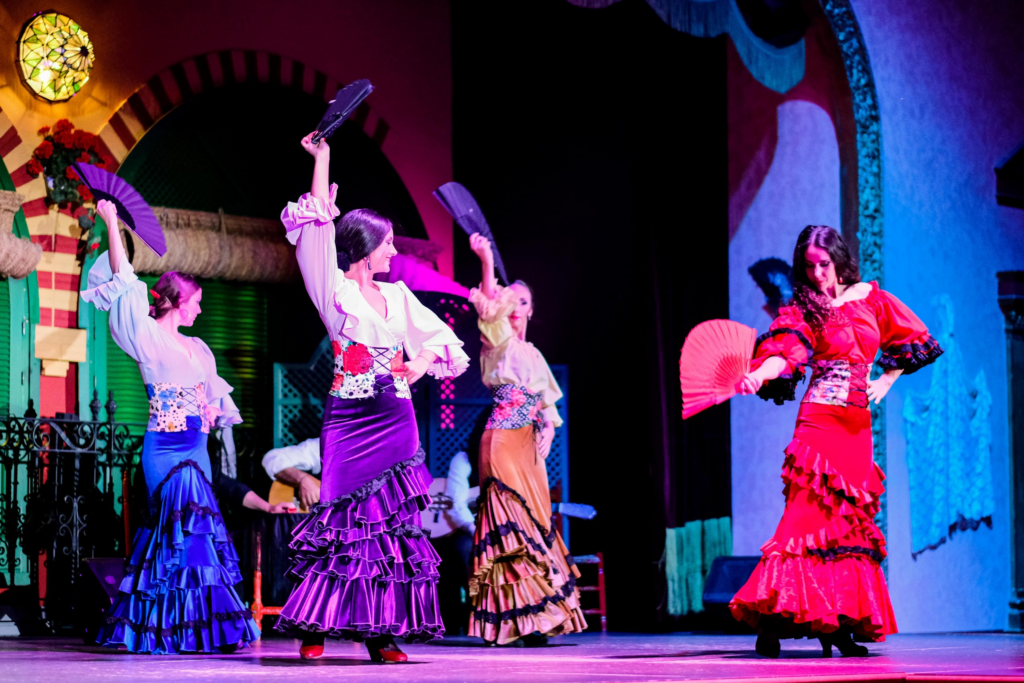
Flamenco dancing is probably what most people visualize when they think of flamenco: the frilled dress, the powerful footwork, the expressive arms, the proud attitude.
What does learning flamenco dance involve?
Footwork: Footwork is fundamental. You will learn to strike the floor with the ball of your foot, heel, and toe, creating complex rhythmic patterns. At first, it's all about coordination and muscle memory.
Arm movement: The arm movements in flamenco are specific, with defined positions and trajectories. It is neither ballet nor contemporary dance; it is its own gestural language that expresses everything from supplication to defiance.
Clapping: Rhythmic clapping is an integral part. There are "muted" claps (muffled sound) and "dry" claps (clear sound), used strategically depending on the moment in the dance.
Rhythm: Understanding and feeling the different flamenco rhythms (12 beats for the soleá, 4 beats for the tango, etc.) is essential. The dancer must be absolutely synchronized with the music.
Posture: The flamenco posture is upright, proud, with chest raised, shoulders back, and weight centered. It conveys dignity and strength.
Facial Expression: The dancer's face is as important as their feet. From the dramatic intensity of a soleá to the joy of alegrías, the face must reflect the emotion of the style.
First steps: what you will learn in your first classes
Beginner level (0-6 months):
- Basic flamenco posture and body placement
- Fundamental steps: strike, heel, ball, toe
- Basic arm movements and hand positions
- Clapping in different rhythms
- Tango rhythm (the most accessible for beginners)
- Exercises to improve coordination between feet and arms
- First simple choreography, usually in tangos or sevillanas
Intermediate level (6 months – 2 years):
- More complex tap dancing with greater speed
- Flamenco styles with complicated rhythms: soleá (12 beats), alegrías
- Spatial rotations and displacements
- Women's flamenco dress technique (long skirt with ruffles)
- I work with a fan and shawl
- Basic improvisation within a choreographic structure
- Basic improvisation within a choreographic structure
Advanced level (2+ years):
- Mastery of flamenco styles (siguiriya, soleá por bulería)
- Virtuoso tap dancing with speed and clarity
- Developed improvisation
- I work with a singer and guitarist live
- Participation in flamenco shows or performances
- Recognizable personal style
Types of flamenco dance classes
Group classes: The most common option for beginners. Social atmosphere, more economical, you learn by watching others. The pace can be too fast or too slow depending on your individual progress.
Private lessons: More expensive but completely personalized. The teacher adapts everything to your level and corrects every detail. You progress faster but lose the social element.
Intensive Workshops: Weekends or full weeks with a specific instructor. Generally focused on a particular stick or technique. Ideal for in-depth study.
Online classes: Increasingly popular. You can learn from teachers who live in another city or country. It requires self-discipline and it's difficult to receive corrections without face-to-face feedback.
Courses in Spain: Weeks or months of immersion in flamenco cities (Seville, Jerez, Granada). A complete cultural experience, constant practice, and living flamenco beyond the classroom.
What do you need to get started
Clothing: At first, you don't need a flamenco dress. Comfortable clothing that allows for movement: tights, a skirt that twirls if you're a woman, fitted trousers if you're a man. As you progress, you'll want full skirts to practice skirt work.
Footwear: This is essential. You need flamenco shoes with nails in the heel and toe to produce the characteristic sound. Women wear heels of 5-8 cm (beginners usually start with 5 cm). Men wear shoes with heels of 3-4 cm. Invest in quality shoes; cheap ones are uncomfortable and break quickly.
Space: You need to practice on a hard floor (wood, tile) so the tapping makes a sound. Avoid carpet or mats. If you live in an apartment and are worried about the neighbors, there are portable practice platforms that absorb some of the sound.
Mirror: Essential for self-correction. You need to see yourself to correct posture, arm movements, and coordination.
Common challenges and how to overcome them
Arm-foot coordination: It's normal to feel like a drunken octopus at first. Your brain is learning to coordinate independent movements. Be patient. Practice your feet alone, then your arms alone, and finally put them together. Progress requires repetition.
Memorizing Choreography: Record yourself on video during classes (with permission), take notes, and rehearse mentally. Muscle memory develops with constant repetition.
Clean tapping: At first, you'll sound like you're dragging furniture. That's normal. Cleanliness comes with practice. Focus on striking cleanly, not quickly. Speed without clarity is useless.
Rhythm: If you have no prior musical training, flamenco rhythms (especially the 12-beat rhythm) can be confusing. Listen to flamenco constantly. Count out loud. Use a flamenco-specific metronome. With time, the rhythm becomes instinctive.
Frustration: There will be times when you feel like you're not making progress. It's part of the process. Flamenco is difficult. Plateaus are normal. Keep practicing, celebrate small victories, and don't compare yourself to more advanced students.
Recommended schools and teachers
In Spain:
- Sevilla: The Flamenco Dance Museum (Cristina Hoyos), Andalusian Flamenco Center
- Jerez: Andalusian Center for Flamenco Documentation, schools of the Moneo and Sotos families
- Madrid: Amor de Dios (historical headquarters), Casa Patas Conservatory Foundation
- Granada: Carmen de las Cuevas, schools in Sacromonte
International:
- Nueva York: Flamenco Vivo Carlota Santana, Peña Flamenca NY
- Londres: Sadler’s Wells Flamenco Festival offers workshops with international teachers
- Berlín: Flamenco Berlin, La Tani
- Tokio: Love of God Tokyo, Studio Angels
Online:
- FlamencoBites.com – Structured tutorials with clear progression
- FlamencoExplained.com – José Maya explaining technique in detail
- Virtual Flamenco – Live classes with interaction
Tips from teachers for beginners
“Don’t rush”: Flamenco requires years of practice. Impatient students want to learn siguiriyas in the second month. First, master the basics. As the flamenco saying goes: “Little by little, you go far.”
“Listen to flamenco constantly”: Not just when you practice. In the car, cooking, working. Your ear needs to become familiar with the styles, the rhythm, the structures.
“See live flamenco whenever you can”: Videos are fine, but live flamenco has an energy that can’t be conveyed through a screen. Go to tablaos, festivals, peñas. Watch how the professionals breathe, pause, and accelerate.
“Connect with the emotion, not just the technique”: You can execute perfect footwork and leave the audience cold. Or you can have imperfect technique but transmit a soul that gives you goosebumps. Obviously, work on your technique, but never forget that flamenco is emotional expression.
“Record yourself frequently”: Watching your own videos is tough (you always look worse than you thought) but it is an invaluable self-correction tool.
Flamenco singing: the voice of the soul
Singing is the oldest and most essential element of flamenco. It is the naked voice expressing the deepest emotions: pain, joy, love, despair, pride.
What does learning flamenco singing involve?
Specific Vocal Technique: Flamenco singing uses vocal techniques distinct from those of opera or popular singing. There are "quejío" (expressive moans), melismas (ornaments), intense vibratos, and the use of falsetto. It's not about "singing beautifully" but about singing with truth.
Knowledge of flamenco styles: There are dozens of flamenco styles, each with its own melodic structure, rhythm, and character. You will learn soleares, seguiriyas, tangos, fandangos, and many more.
Rhythm: As a dancer, the singer must master the rhythm. But they must also know where to "stretch" or "compress" the time for expressive effects, always returning to the rhythm.
Lyrics: Flamenco poetry (coplas) speaks of love, death, prison, work, loneliness, and joy. Learning to sing means memorizing hundreds of coplas and understanding their profound meaning.
Breathing: Flamenco singing requires extraordinary breath control. Some phrases can last 20-30 seconds without taking a breath.
Stamina: Singing flamenco is physically demanding. It requires sustained vocal power. Professional flamenco singers can sing for hours at a party.
First steps in singing
Beginner level:
- Breathing and vocal projection exercises
- Learn the basic rhythm of tangos and fandangos
- First simple verses
- Voice warm-up
- Listen to and copy (forward) recordings of great flamenco singers
Intermediate level:
- Flamenco styles with complex rhythms: soleá, alegrías
- Melisma and ornamentation techniques
- Developing a personal voice (not just imitation)
- Singing with guitarist
- Improvisation of lyrics over known structures
Advanced level:
- Palos jondos: siguiriya, malagueña, granaína
- Recognizable personal style
- Singing for dance (knowing when to tap, when to leave space)
- Create your own letters
- Participate in professional shows
Myths and realities about flamenco singing
Myth: "You have to be a Gypsy to sing flamenco well." Reality: Although many great flamenco singers are Gypsies, there are extraordinary non-Gypsies. What you need is to understand the deep emotional expression that flamenco requires, and that transcends ethnicity.
Myth: "You need a 'pretty' or powerful voice." Reality: Some of the most respected flamenco singers have raspy, raspy voices. What matters is expression, the soul, the emotional truth. That said, you do need enough vocal power to project without a microphone.
Myth: "It's impossible to learn without a teacher." Reality: Traditionally, it was true that learning only took place with a teacher. Today there are more resources, but a good teacher remains invaluable. They will correct bad habits and teach you subtleties impossible to grasp simply by listening to recordings.
Myth: "You have to have suffered a lot to sing with feeling." Reality: Having lived through life certainly helps. But it's also a matter of empathy, imagination, and the ability to channel universal emotions. A 20-year-old flamenco singer can convey profound sorrow if they genuinely connect with the emotion of the song.
Vocal care
Flamenco singing is demanding on the vocal cords. Essential care:
- Hydration: Drink water constantly. Avoid caffeine and alcohol before singing.
- Warm-up: Never sing at full volume without warming up. Vocal tone is essential.
- Rest: If you feel pain (other than normal tiredness), stop. Straining an injured voice causes permanent damage.
- Correct Technique: Singing from the throat without breath support damages the voice. Learn to sing from the diaphragm.
- Don't smoke: Tobacco is the enemy of the voice. Many classical flamenco singers smoked (it was part of the culture), but they paid the price with prematurely deteriorated voices.
Where to learn singing
The same cities mentioned for dance (Seville, Jerez, Madrid, Granada) also have master singers. Additionally:
- Flamenco clubs: Cultural associations where flamenco enthusiasts meet. Many offer classes. The informal atmosphere is ideal for overcoming shyness.
- Workshops with professional flamenco singers: Many offer intensive workshops when they are not on tour.
- Conservatories: Some Spanish conservatories have chairs of flamenco singing.
- Online: Platforms such as CompásFlamenco.com or classes via Skype/Zoom with teachers.
Flamenco guitar: the magic touch
We've already discussed great guitarists at length in the previous article. Here we focus on how to learn.
What does learning flamenco guitar involve?
Specific techniques:
- Strumming: Striking the strings with the fingers of the right hand to create rhythmic patterns. There are dozens of types.
- Alzapúa: Thumb technique that combines individual note with strumming.
- Picado: Rapid scales with alternating index and middle fingers.
- Tremolo: A technique where one finger sustains a note (usually the thumb on a bass string) while the others (ring-middle-index-ring-middle-index…) create a tremolo effect on a treble string.
- Stroke: Strike the guitar top with the ring finger for a percussive effect.
Rhythm: Like all flamenco artists, mastering rhythm is non-negotiable.
Falsetas: Melodic variations characteristic of each flamenco style. You will learn traditional falsetas and eventually create your own.
Harmony: Flamenco uses modal harmony (primarily Phrygian and Aeolian modes) distinct from standard Western major-minor tonal harmony. You will learn characteristic progressions such as the Andalusian cadence (Am – G – F – E).
Accompaniment: Playing for singing or dancing requires special sensitivity: knowing when to play loudly, when to be silent, how to "dress" the singer without overshadowing him.
First steps with the flamenco guitar
Beginner level:
- Correct posture (guitar on right leg for flamenco, different from classical guitar)
- Basic strumming
- Fundamental chords
- Rumba and tango rhythms
- First simple falsetas
- Right-hand-left hand coordination
Intermediate level:
- Fluid lifter
- Chopped with clarity and increasing speed
- Basic Tremolo
- Palos with a 12-beat rhythm: soleá, alegrías
- Accompaniment for singing
- Composition of simple falsetas
Advanced level:
- Technical mastery of all resources
- Palos jondos
- Improvisation
- Personal style
- Professional accompaniment for dance and singing
- Public performances
Do you need to know classical guitar first?
It's a perpetual debate. My opinion:
Advantages of starting with classical:
- You learn to read sheet music
- Solid left-hand and right-hand technical fundamentals
- Repertoire that develops general musicality
Disadvantages:
- Right-hand posture and techniques are different
- You could develop habits that you then have to unlearn.
- It can take months/years before playing flamenco
My recommendation: If your goal is flamenco, start directly with flamenco. You'll learn the necessary technique within a flamenco context. If you want to be a well-rounded musician and have years ahead of you, a few years of classical music won't hurt, but it's not a requirement.
What guitar to buy
Absolute beginner: Don't spend a fortune yet. A decent Spanish guitar made of cypress will cost you €200-400. Brands like Alhambra, Prudencio Sáez, and Admira have student models.
Serious student (1-2 years): €600-1,200. Guitars that already sound good. Alhambra mid-range, Conde Hermanos basic, Vicente Carrillo student.
Advanced: €1,500-€5,000. This includes concert guitars. Conde Hermanos, Gerundino Fernández, Manuel Reyes Jr., Vicente Carrillo (professional).
Professional: €5,000+. Renowned luthiers. Custom instruments. At this level, the guitar is a serious investment and a lifelong companion.
Important: The typical flamenco guitar is made of cypress (brighter, more percussive). Some people prefer rosewood (warmer, with more sustain). Try both if you can.
Resources to learn
Classical methods in a book:
- "Flamenco Guitar Method" by Gerhard Graf-Martinez
- “The Flamenco Guitar” by David Leiva
- Juan Martín Series
Online:
- Flamenco Chuck (great for English speakers)
- FlamencoExplained.com (detailed technique)
- YouTube: Channels of Kai Narezo, Paco Lara, Jerónimo de Carmen
Apps:
- Flamenco Rhythm (for practicing rhythms)
- Guitar Pro / TuxGuitar (to read tablature)
Common beginner mistakes
Jumping into rapid, unclear phrasing: Speed without clarity is just noise. Practice slowly with a metronome. Speed comes with time.
Excessive tension: Relaxation is key. If your hands/shoulders are tense, you sound strained and risk injury. Breathe, relax.
Not practicing with a beat: Many students practice isolated techniques without rhythmic context. Always practice with a beat, a metronome, and backing tracks.
Ignore the left hand: The right hand commands attention (strumming, percussion), but the left is just as important. Practice clean barre chords, speed of changes, and vibrato.
Don't listen to flamenco: You can't play a style you don't know by ear. Listen to flamenco voraciously. Analyze what the guitarists do.
General advice for any flamenco discipline
These principles apply whether you dance, sing, or play instruments:
1. Patience and persistence
Flamenco isn't mastered in months, or even a few years. Professionals have decades of practice. This shouldn't be discouraging, but rather liberating: there's no rush. Enjoy the journey, celebrate every small step forward.
2. Immerse yourself in the culture
Learn the history of flamenco, read Andalusian poetry, study the masters, and understand the social and cultural context. Flamenco is not just technique; it's an expression of a culture. The more you understand that culture, the deeper your flamenco will be.
3. Participate in the community
Go to flamenco clubs, festivals, and informal gatherings. Meet other students and professionals. Flamenco is a community art. It thrives on interaction, exchange, and mutual inspiration.
4. Accept vulnerability
Flamenco requires raw emotional expression. You will feel vulnerable, especially singing or dancing in front of others. That vulnerability is part of the art. Accept it, work with it, and eventually it will become strength.
5. Find your teacher
You can learn a lot from books and videos, but nothing replaces a good teacher. Someone who sees your specific mistakes, adapts their teaching to your progress, and inspires you personally. Keep searching until you find a teacher who connects with you.
6. Practice consistently
Better to exercise 20 minutes a day than 3 hours once a week. Consistency builds muscle memory, reinforces learning, and maintains steady progress.
7. Record yourself and self-evaluate
It's tough to watch/listen to yourself objectively, but it's a powerful tool for improvement. Record yourself regularly, compare with previous recordings, and identify areas for improvement.
8. Don't compare yourself destructively
There will always be someone better than you. Always. Use your mentors as inspiration, not as a yardstick that makes you feel inadequate. Your only competitor is the you of yesterday.
9. Take care of your body.
Flamenco is physically demanding. Warm up before dancing, stretch afterward. If you sing, take care of your voice. If you play guitar, take care of your hands. Injuries can set you back for months.
10. Have fun
Yes, flamenco is serious, profound, and technically demanding. But it's also joy, celebration, and play. If it becomes just work without pleasure, something is lost. Find the balance between discipline and enjoyment.
The path of flamenco: realistic expectations
First year: You will master the basics of your discipline. You will be able to perform simple choreographies, sing simple songs, or play traditional falsetas. You will feel both clumsy and competent, but you will have progressed immensely.
Years 2-3: You will begin to feel genuinely comfortable. Your sense of rhythm will become more intuitive. Your technique will be visible. You will be able to tentatively improvise. You will participate in student performances.
Years 4-5: If you have practiced seriously, you will have a solid level. You will be able to dance, sing, or play most styles competently. Your personal style will begin to emerge.
Years 6-10: Transition from advanced student to semi-professional or professional (if that's your goal). You'll delve deeper into complex sticks, develop a true personal style, and perhaps even start teaching.
10+ years: Mastery. But even professionals in their 30s continue learning. Flamenco is so rich that it's never truly mastered.
Conclusion: the call of flamenco
Learning flamenco is embarking on a transformative journey. You don't just learn an artistic skill; you connect with a centuries-old tradition, develop deep emotional expression, join a global community of enthusiasts, and discover parts of yourself you may not have known existed.
Is it easy? No. Does it require years of dedication? Yes. Is it worth every minute of frustrated practice, every sore muscle, every embarrassing moment while you learn? Absolutely.
Because flamenco teaches you that vulnerability is strength, that unfiltered emotional expression is liberating, that true art comes from an authentic inner place, not from following external formulas.
The first step is the hardest: deciding to begin. But once you take that step, the path opens up on its own.
You begin with doubts, awkwardness, and respect for an art that commands respect. And without realizing it, flamenco begins to accompany you: in the way you listen to the music, in how you walk, in how you express what you feel. The rhythm seeps into you, your body learns to speak without words, and emotion finds an outlet.
It doesn't matter how old you are when you start, or if you come from music, dance, or absolutely nothing. Flamenco doesn't ask for a resume: it asks for honesty, perseverance, and a desire to feel. Every rehearsal, every mistake, every moment of frustration is part of the learning process. And every small step forward—a footwork that finally sounds clean, a lyric that resonates deeply, a falseta that flows—is celebrated as a personal victory.
If anything you've read here has stirred something within you, don't ignore it. Find a class. Listen to more flamenco. Go to a flamenco club. Buy those shoes, that guitar, dare to sing even if your voice trembles. The duende doesn't appear when everything is perfect; it appears when you truly give yourself over to it.
The path of learning is long, but profoundly rewarding. An excellent way to train your ear while practicing is to learn about the different rhythms and variations that exist; for this, our Complete Guide to Flamenco Styles and Dance Techniques will be your best academic ally.
No responses yet