
Flamenco dance is pure expression of emotion transformed into movement. Every turn, every footwork, every arm position tells a story without words. It is where technique meets passion, where years of disciplined training combine with the improvisation of the moment to create ephemeral art that exists only for the duration of the performance.
In this comprehensive guide to flamenco dance 2026, we explore the different palos and styles of flamenco dance, the fundamental techniques that every dancer must master, the difference between male and female dance, how the dance has evolved through the decades, the legendary figures who defined the art, and how contemporary flamenco dance continues to innovate while respecting tradition.
The essence of flamenco dance: more than technique
Before we delve into specific techniques, let's understand what makes flamenco dancing unique.
The body as a total instrument
In flamenco, every part of the body communicates:
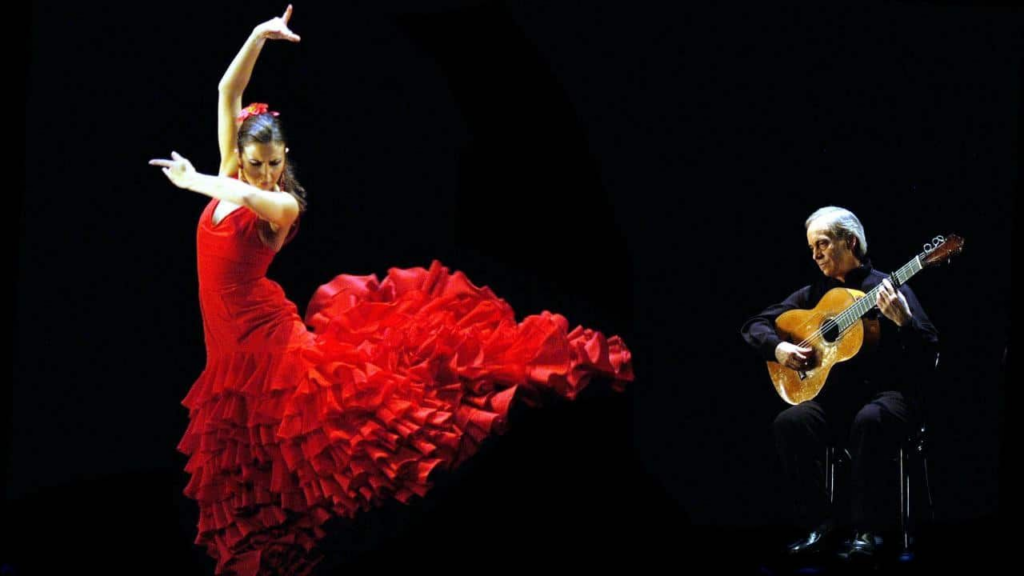
The feet: They don't just set the rhythm; they converse with the music. The footwork isn't random percussion but a structured dialogue with the guitarist and the beat. An expert dancer can create complex rhythmic variations using only their feet, responding to what the guitarist plays or anticipating what the singer is going to sing.
The Hands and Arms: Flamenco arm movements are unmistakable. The hands are never rigid; they flow like water, closing in moments of intensity and opening in moments of release. The arms create frames, draw circles, and cut through the air with precision. Each position has a name and function: high arm movements, low arm movements, arms in a crown, crossed arms.
The chest: The flamenco posture is upright, proud, with a lifted chest. But not rigid; the torso arches, contracts, and twists. The spine is the axis around which everything moves.
The Head and Gaze: The head follows the body's movement but also has a life of its own. Head turns emphasize key moments. The gaze can be defiant, pleading, distant, penetrating. A flamenco dancer who doesn't use their gaze is only telling half the story.
The Hips: Unlike Latin dances where the hips are the main focus, in flamenco the hip movement is more subtle, more restrained. But it's there, especially in the women's dance, adding a sensual touch without being explicit.
Rhythm: the soul of the dance
Rhythm is everything in flamenco. You can have perfect technique, but if you don't have rhythm, you have nothing.
What is the compás: It's the rhythmic cycle of each palo. It's not simply a metronome; it's the pattern of accents that gives character to each style. Soleá and bulería share a 12-beat compás, but the accents fall in different places, creating completely distinct feelings.
Feeling vs. Counting: Beginners count mentally ("1, 2, 3, 4…" up to 12 in soleá). Experienced dancers feel the rhythm in their bodies. It's instinctive, visceral. They know where they are in the cycle without thinking.
Playing with the rhythm: Great flamenco dancers don't just respect the rhythm; they play with it. They can create tension by delaying an accent, or surprise by speeding it up. But they always, always return to the rhythm. That tension and resolution is part of the magic.
Goblin at the dance
The duende is that magical moment where everything aligns: technique, emotion, music, atmosphere. The dancer transcends mechanical execution and touches something deeper.
How to recognize it: When you see a duende dance, your body reacts involuntarily. Your skin prickles, your stomach clenches, you hold your breath. Time seems to stand still.
It can't be forced: The duende appears when it wants to. A flamenco dancer can have the same choreography and execute it perfectly, but only sometimes will they have duende. It depends on a thousand variables: the dancer's emotional state, the energy of the audience, the chemistry with the musicians, even factors that no one can explain.
Why it matters: Flamenco without duende is mere gymnastics, a technical display. It may impress, but it doesn't transform. Duende is what turns dance into transcendent art.
The fundamental technical elements of flamenco dance
Footwork: the percussion of the feet
The footwork is possibly the most recognizable element of flamenco dance.
Basic techniques:
Stroke: The entire sole of the foot strikes the ground. It produces a full, deep sound.
Heel: Only the heel strikes. Higher, sharper sound.
Toe: Only the front part of the foot. Lighter, faster sound.
Plant: Similar to a strike but with emphasis on the front part before the heel touches down.
Combinations: Flamenco dancers combine these elements in sequences: heel-toe-ball-heel, for example. The possibilities are endless.
Speed and clarity: Fast tapping is impressive, but clarity is more important. Each stroke should be distinct. Fast but muddy tapping (sounds that blend together) is no good.
Zapateo vs zapateado: «Zapateo» is the act; «zapateado» is the technique or dance section dedicated to foot percussion.
Gender Differences: Traditionally, men emphasized footwork (strength, speed, technical complexity). Women incorporated footwork, but balanced it with arm movements and skirt work. However, modern flamenco dancers like Sara Baras have demonstrated footwork as powerful as any man's.
Arm swing: the language of the arms
The arm movements are what give flamenco its characteristic elegance.
Fundamental positions:
First position: Arms rounded in front of the chest, as if holding a large ball.
Second position: Arms extended to the sides, slightly rounded, at shoulder height.
Third position: One arm in first, the other in second.
Fourth position: Arms raised, forming a frame above the head.
Movements:
Flourish: Rotation of wrists and hands. The hands "flourish" like flowers opening.
Facing: Bringing hands towards the face and away from it, as if framing the face.
Circular arm swing: Arms describe complete circles, generally from bottom to top or vice versa.
Cut arm swing: Angular, abrupt movements that cut through the air with precision.
Hand aesthetics:
Flamenco hand positions are characteristic: fingers together but not rigid, thumb slightly separated, wrist relaxed to allow for fluid movement. The hands are never completely flat nor completely closed into fists (except at specific moments for dramatic effect).
Arm-body coordination: Arm movements are not isolated; they flow from the center of the body. The movement begins in the torso, travels through the shoulder, continues down the arm, and culminates in the hand. This fluidity is what gives grace to arm movements.
Chest and posture work
Characteristic flamenco posture:
- Upright but not rigid spine
- Chest raised (sternum lifted, as they say in English)
- Shoulders back and down (not hunched)
- Elongated neck
- Balanced head, chin slightly raised
This posture conveys pride, dignity, and strength. It is the flamenco attitude.
Chest movements:
Quiebro: Arching the back backward, usually with arms raised. A dramatic movement, especially at the end of sentences.
Contraction: The torso contracts, shoulders forward, as if withdrawing. It communicates internalization, pain.
Rotations: The torso rotates on its axis. Used in turns and changes of direction.
Undulations: Fluid movements of the spine, like a wave that travels through the body. More common in female dance.
Displacements and turns
Walks: Walking with intention. In flamenco, even walking is choreographed. The walk can be slow and majestic, or fast and dynamic. The feet never drag; every step is deliberate.
Turns (spins):
Flamenco turns have a specific character. They are not the multiple turns of ballet; they are generally single or double turns, but executed with flamenco attitude.
Return technique:
- Preparation with arms
- Spot (fix your gaze on a point and quickly turn your head back to it)
- Weight on supporting leg
- Controlled end, usually in a stable position
Return types:
- Normal turn: A complete turn on one foot
- Broken turn: A turn that stops abruptly in the middle, changing direction
- Turn with a flourish: Turn that ends with a strong foot stomp
Clapping and whistling
Although they are not dance movements per se, many dancers incorporate clapping and finger snapping while dancing.
Function: They add an extra percussive layer, emphasize rhythm, and fill musical silences.
Challenge: Clapping while dancing requires extraordinary coordination. You're tapping your feet, moving your arms, turning, and also clapping in time. It's extreme multitasking.
The styles of flamenco dance
Each flamenco style has its own character, rhythm, and associated dance techniques.
Joys: Cadiz celebration
Compass: 12 beats, similar to soleá but with a completely different character.
Character: Cheerful, bright, festive. Originally from Cádiz, it captures the optimistic spirit of the coastal city.
Dance:
- Lots of fluid arm movements
- Zapateado present but not dominant
- A smile on the face (unlike more serious sticks)
- Skirt work (for women) – making the skirt twist and ripple
- Explosive finishes with powerful shots
Characteristic techniques:
- Escobilla (fast tap section)
- Castellana (characteristic promenade of alegrías)
- Quick changes of direction
Famous dancers in alegrías: La Chana, Matilde Coral, Antonio Canales.
Soleá: the mother stick
Time signature: 12 beats with accents on 3, 6, 8, 10, 12.
Character: Profound, introspective, majestic. The soleá (from "solitude") deals with themes of lost love, sorrow, and existential reflection.
Dance:
- Slow at first, it allows for the development of emotional expression.
- Wide, dramatic arm swing
- Zapateo is present but at the service of expression, not exhibition.
- Intense, inward gaze
- Pronounced breaks
- Endings generally by bulería (acceleration)
Characteristic techniques:
- Callouts (sequences that signal changes in the music)
- Plantings (strong section ends)
- Shawl work (if used)
Famous dancers in soleá: Matilde Coral, Merche Esmeralda, El Farruco, Joaquín Cortés.
Bulería: the heart of festive flamenco
Time signature: 12 beats, the fastest of the 12-beat time signatures.
Character: Festive, improvised, explosive. Bulería is the style of revelry, where dancers showcase their personality and improvisational skills.
Dance:
- Fast, energetic
- Lots of improvisation
- Complex and fast tap dancing
- Interaction with the audience (winks, smiles, complicity)
- Sudden changes in rhythm and direction
- Surprise finishes
Characteristic techniques:
- Punchlines (explosive sentence endings)
- Quick hand flourishes
- Kicks (leg strikes)
- Intensity fluctuations
Context: Bulería is the most "democratic" flamenco style – at flamenco parties, anyone can get up and dance bulerías. It's where you see who has rhythm and who doesn't.
Famous bulería dancers: Farruco, La Farruca, Israel Galván, Farruquito.
Siguiriya: the deepest
Compás: Complex, with 12 beats but with an asymmetrical distribution that makes it feel completely different from soleá or bulería.
Character: The deepest, most tragic, most solemn. The siguiriya deals with death, inexorable destiny, existential pain.
Dance:
- Slow, heavy, earthly
- Contained movements charged with tension
- Few turns, little virtuoso footwork
- Intense, serious facial expression
- Use of silence – the dancer can remain completely still during moments of particularly intense singing
- When there is footwork, it is deep, heavy, like hitting the ground
Characteristic techniques:
- Marking (marking the beat with the body without excessive movement)
- Use of heavy, non-floating arms
- Expressive stasis
Rarities: Not all flamenco dancers perform siguiriya. It requires artistic and emotional maturity. It's rare to see siguiriyas performed in tourist venues; it's more common in traditional flamenco clubs and festivals.
Famous seguiriya dancers: El Farruco, Matilde Coral, Antonio Gades (in "Blood Wedding").
Tangos: rhythm and joy
Time signature: 4 beats, the most accessible for untrained ears.
Character: Rhythmic, cheerful, earthy. Flamenco tangos (not to be confused with Argentine tango) have contagious energy.
Dance:
- Prominent taping
- More pronounced hip movements than in other styles
- Constant, insistent rhythm
- I play with the public
- Smiles, winks
Variants: Tangos de Triana, tangos extremeños, tanguillo (from Cádiz, faster and more festive).
Famous tango dancers: Carmen Amaya was a tango teacher. Antonio Gades, Cristina Hoyos.
Fandango: regional variety
Time signature: 3/4 or 6/8 depending on the regional variant.
Character: Varies greatly depending on the region. Fandangos from Huelva are different from malagueñas (fandango from Málaga), which differ from granaínas (Granada).
Dance:
- Fluid, undulating movements
- Especially important arms
- Footwork less prominent than in other styles
- Frequent turns
Particularity: Many fandangos are danced without strict rhythm (a palo seco), allowing greater expressive freedom.
Farruca: the quintessential male dance
Compass: 4 beats, similar to tangos but slower, more dramatic.
Character: Originally an exclusively male dance. Serious, restrained, powerful.
Dance:
- Strong, masculine footwork
- Arms in angular, not rounded, positions
- Haughty, almost military posture
- Little flowery arm movement
- Lots of leg work
Evolution: Although originally masculine, modern flamenco dancers like Sara Baras have reclaimed the farruca, dancing it with a strength comparable to any man.
Famous dancers in farruca: El Farruco (from whom it takes its name), Antonio Gades, Joaquín Cortés, Sara Baras.
Male dance vs female dance
Traditionally, male and female flamenco dancing had distinct characteristics.
Traditional stereotypes
Traditional male dance:
- Emphasis on footwork (strength, speed, complexity)
- Bracing more contained, angular
- Upright, almost rigid posture
- Less hip work
- Serious, restrained facial expression
Traditional female dance:
- Zapateado present but not dominant
- Fluid, rounded, flowery arming
- Skirt work (making the skirt ripple and twirl)
- Use of shawl, fan
- More noticeable hip movements
- Greater facial expressiveness
The revolution: flamenco dancers break stereotypes
Since the 1980s and 90s, flamenco dancers have challenged these roles:
Carmen Amaya (1913-1963): An absolute pioneer. She danced with "masculine" strength; her footwork was as powerful as any man's. She even wore trousers (scandalous in her time).
Sara Baras (1971-present): Technically impeccable, her footwork equals or surpasses that of many men. She dances farruca (a traditionally male style) with absolute authority.
Rocío Molina (1984-present): She takes deconstruction further. Her dance defies all categories. She uses stiletto heels for impossible tap dancing. She incorporates elements of performance art.
Result: Today, gender distinctions in flamenco dance are more fluid. Female dancers can dance with all the traditionally "masculine" force. Male dancers incorporate traditionally "feminine" elements such as expressive handwork.
The evolution of flamenco dance through the decades
Pre-recording era (before 1900)
We have no visual record, but we know from written descriptions that dance was an integral part of flamenco from the beginning. At Gypsy inns and parties, the dance was spontaneous and communal.
Singer coffee (1850-1920)
Dance becomes professionalized. Female dancers become stars. La Malena and La Macarrona are legendary names. Dance becomes more stylized and refined.
Characteristics:
- Emphasis on grace, elegance
- Development of specific techniques (arm swing, coded footwork)
- Specific attire (flamenco dress – long skirt with train)
Flemish Opera (1920-1955)
Dance becomes theatrical. Large groups, elaborate choreography, spectacular production.
Figures: La Argentinita, Carmen Amaya (who revolutionizes with her strength).
Renaissance and Purism (1955-1980)
Backlash against commercialization. A return to roots, but with refined technique.
Figures: Antonio (Antonio Ruiz Soler), Pilar López, Matilde Coral, Antonio Gades.
Gades' contribution: He brings flamenco dancing to theaters around the world with productions that combine flamenco with dance-theater: "Blood Wedding", "Carmen", "El Amor Brujo".
Creative explosion (1980-2000)
New choreographers and dancers experiment while respecting tradition.
Figures: Joaquín Cortés (brings flamenco to stadiums with massive productions), Sara Baras, Eva Yerbabuena, Belén Maya.
Contemporary Flamenco (2000-present)
Radical experimentation. The boundaries of flamenco are expanding.
Figures:
- Israel Galván: Deconstructs flamenco dance. Incorporates elements of butoh dance and experimental music.
- Rocío Molina: Performance art meets flamenco. She uses non-traditional elements (stiletto heels, stage props).
- María Pagés: She fuses flamenco with contemporary dance while maintaining the essence of flamenco.
Debate: Where is the limit? How much can you experiment before it ceases to be flamenco? This healthy debate keeps the genre alive.
How to learn flamenco dance
First steps
Find a good teacher: Essential. You need someone who corrects posture, teaches rhythm correctly, and conveys not only technique but also spirit.
Realistic expectations: Flamenco is difficult. You will feel clumsy for the first few months. This is normal. Arm-leg coordination takes time to develop.
Practice regularly: 20 minutes a day is better than 3 hours once a week. The body needs constant repetition.
Listen to flamenco: Constantly. Your ear needs to become familiar with rhythms, structures, and styles.
See flamenco live: Whenever you can. Watching masters inspires you and teaches subtleties impossible to capture on video.
Typical progression
First year:
- Basic posture
- Fundamental zapateado
- Basic armrest
- Tango rhythm (the most accessible)
- First simple choreography
Years 2-3:
- More complex tap dancing
- 12-measure bars (soleá, alegrías)
- Controlled laps
- More choreographies
- First student performances
Years 4-5:
- Basic improvisation
- Siguiriya and complex sticks
- A personal style begins to emerge
- Most frequent actions
10+ years:
- Technical mastery
- Advanced improvisation
- Possible career path or teaching
Conclusion: dance as a conversation without words
Flamenco dance is a language. Every movement is a word, every choreography a conversation. It's a way of saying things that words cannot express: sorrow so deep it cannot be contained in sentences, joy so intense it must explode in movement, pride communicated through posture.
It is ancient art that continues to evolve. Each generation contributes its voice while respecting the voices that came before. It is a living tradition, not a museum.
Mastering flamenco dance requires years of discipline, but understanding its structure is the first step to feeling the 'duende' in every footwork. If you want to delve deeper into the rhythm that guides your steps, don't miss our Guide to the Best Guitarists in History, the true masters of rhythm who make every flourish possible.
No responses yet